
Why Choose Intelligent Lighting Poles for Smart Cities?
An Intelligent Lighting Pole can do more than illuminate a street. It can combine efficient LED lighting with sensors, communications equipment, and environmental monitoring. When thoughtfully planned, these features help cities manage public spaces and infrastructure with better visibility. The pole at a busy crossing, for example, may support lighting controls while providing a mounting point for traffic or air-quality sensors. Less clutter. More useful data.
Urban-design expert Jan Gehl wrote, “First we shape the cities—then they shape us.” His observation offers a useful lens for evaluating connected street infrastructure. Technology should serve people moving through real places, not simply make a city look modern. A well-designed pole may adjust light levels to changing conditions, support maintenance planning, and fit a coordinated streetscape. These outcomes depend on sound installation, compatible systems, and clear plans for upkeep. The hardware alone cannot deliver them.
There are trade-offs. More devices can mean more maintenance, integration work, and questions about data handling. A pole crowded with equipment may also look awkward beside a historic façade or narrow sidewalk. That matters. City planners and operators should assess local needs, accessibility, energy use, and long-term service costs before choosing a design. The answer will not be identical on every street. This guide explores where Intelligent Lighting Pole systems can offer practical value, what to check before deployment, and why thoughtful planning matters as much as advanced features.
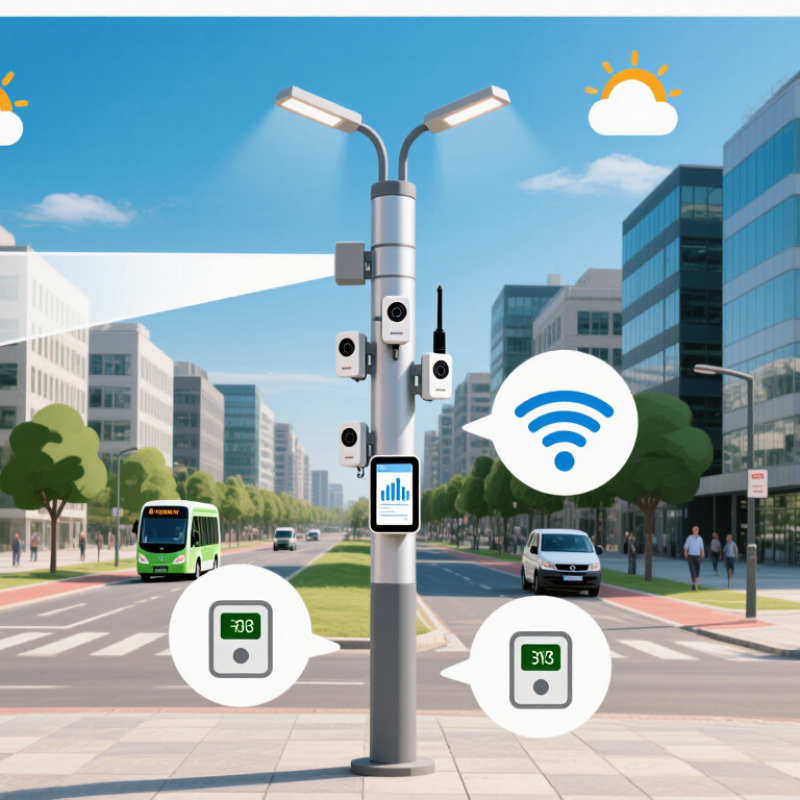
An intelligent lighting pole is a streetlight designed to support additional urban services. Alongside an energy-efficient luminaire, it may carry environmental sensors, traffic counters, cameras, or wireless communication equipment. The exact setup depends on local needs. It is not a single, fixed technology package.
Its role is to provide a shared mounting point and, where designed for it, power and network connections. A pole might adjust lighting when a road becomes quiet, while nearby sensors measure temperature or air conditions. Data can help city teams understand street activity and plan maintenance.
Not just a lamp.
It can become a small part of the city’s digital infrastructure.
Good integration takes practical planning. Equipment needs reliable power, suitable network coverage, safe access for technicians, and clear rules for data collection. A crowded pole can be harder to maintain than a simple one. That trade-off is easy to underestimate. Cities should also check whether devices from different suppliers can exchange data, and whether services can keep working during network interruptions. Intelligent poles can support useful applications, but they do not replace careful design, regular upkeep, or thoughtful decisions about what information is truly needed.
An intelligent lighting pole combines several working parts, not just a brighter lamp. LED luminaires provide efficient, directional light for roads and walkways. Their optics matter: a poorly aimed fixture can leave dark patches or send glare into nearby windows. At dusk, photocells can trigger scheduled dimming, while motion sensors may raise output when people approach. Small details count.
Sensors measure conditions such as ambient light, movement, or air quality. Their readings help controls adjust lighting levels instead of keeping every fixture at full output all night. A control unit can apply schedules, report faults, and allow maintenance teams to check a lamp remotely. However, sensor data is not always clear. A passing branch or vehicle may trigger movement detection, so settings need testing on site.
Wireless nodes connect each pole to a wider network, carrying status and control signals between fixtures and management software. Mesh communication can help messages move around a failed node, though coverage depends on pole spacing, buildings, and interference. Reliable designs also need fallback settings if communication drops. Integration can be messy in practice; older wiring and mixed equipment may complicate installation. A site survey and gradual commissioning help reveal those issues before every pole is connected.
Core components and representative operating power
LED luminaires typically account for most of a smart pole’s operating load. Sensors, controls, and wireless nodes add connectivity and local intelligence with comparatively low power demand. Values are representative estimates; actual consumption varies by equipment, configuration, and operating conditions.
Intelligent lighting poles can turn streetlights into efficient, responsive city infrastructure. The U.S. Department of Energy’s 2017 report, Adoption of Light-Emitting Diodes in Common Lighting Applications, says LED streetlights can use 50% or less energy than conventional technologies. That difference matters across thousands of fixtures, where every overnight operating hour adds up. LEDs also direct light more precisely, helping reduce wasted illumination on empty sidewalks and building façades.
Add smart controls, and savings can go further—but only when the system is configured well. Dimming lights during quieter hours can reduce electricity use while keeping roads visible. Motion or traffic sensors may help adjust brightness in real time. Results vary with existing equipment, schedules, weather, and maintenance. A poorly aimed fixture or an overly bright setting can erode the benefits. Smart does not mean automatic perfection.
Tips: Start with a nighttime audit. Record current energy use, check light levels at crossings, and test dimming schedules on a small group of poles. Compare meter readings before and after installation; then adjust settings based on measured results. Don’t assume every block needs the same brightness.
UUN DESA projects that 68% of the world’s population will live in urban areas by 2050. That shift means more people sharing streets, transit stops, and public spaces, often during the same busy hours. Cities will need infrastructure that serves several needs without filling sidewalks with separate equipment. Intelligent lighting poles can combine streetlights with sensors, communications equipment, and environmental monitoring devices. A pole on a crowded avenue might adjust light output as evening traffic changes, while monitoring local air conditions.
The value depends on the city’s actual needs. A dimmer setting can reduce energy use when streets are quiet, but safe visibility must remain the priority.
Sensors may help teams identify maintenance issues or understand how public spaces are used. Useful information. But collecting it requires clear limits, secure systems, and public trust. Hardware also needs routine inspection; a connected pole is still exposed to rain, dust, and accidental damage.
Technology is not a city plan. Some installations may add complexity without solving a pressing local problem. Careful pilots, measured energy and maintenance results, and input from residents can help planners decide where intelligent lighting poles make sense as urban populations grow.
Intelligent lighting poles can combine streetlights, sensors, and communications equipment, but integration should be planned before installation. Require documented interfaces, exportable data, and conformance tests across vendors. Compatibility is earned. A pole that works with one control platform today may become costly to maintain when software or contractors change.
Cybersecurity belongs in the deployment specification, not as a later software add-on. NISTIR 8259 identifies baseline IoT capabilities such as secure configuration, data protection, and software updates. In practice, cities should inventory each device, restrict management access, and verify update procedures before commissioning. Small gaps matter. A forgotten default credential can undermine an otherwise well-designed network.
Lifecycle costing should include energy, connectivity, software support, inspections, and replacement parts—not just the pole’s purchase price. A 2017 U.S. Department of Energy report describes energy savings of 50–70% from LED street-lighting upgrades; actual results depend on the existing system and design. Model those savings alongside maintenance and network fees. One uncomfortable detail: early estimates often assume smooth integration. Pilot a few streets first, then revise the cost model using real installation hours and fault records.
| Deployment priority | Dimension | Practical requirement or measure | How to verify | Why it matters over the lifecycle |
|---|---|---|---|---|
| Interoperability | Luminaire-to-controller interface | Specify an open, documented interface and define the required functions, such as dimming, switching, status reporting, and fault alerts. DALI-2 is a standardized digital lighting-control system. | Request conformance documentation and test representative luminaires and controllers together before mass deployment. | Reduces dependence on a single product ecosystem and makes future component replacement easier. |
| Interoperability | Outdoor node connector | Where applicable, choose a documented outdoor receptacle-and-node approach. ANSI C136.41 specifies a locking-type photocontrol interface with electrical contacts for dimming control. | Confirm the receptacle, node, pin configuration, electrical ratings, and control functions are compatible as a complete assembly. | Supports field replacement of control nodes without replacing the entire luminaire, subject to compatibility and local requirements. |
| Interoperability | Multi-vendor data exchange | Document the device inventory, data model, API or protocol, time synchronization, and ownership of configuration data. Avoid undocumented interfaces for essential operations. | Run an integration test with the intended lighting-management platform and verify that asset, status, and fault data can be exported in a usable format. | Improves the ability to connect future systems and transfer operational data if a platform changes. |
| Interoperability | Expansion and smart-pole equipment | Define available power, mounting space, thermal limits, communications pathways, and reserved capacity for sensors or other approved equipment. | Review pole drawings, electrical load calculations, environmental ratings, and installation clearances before procurement. | Prevents costly retrofits when additional equipment is added later. |
| Cybersecurity | Security governance | Use the NIST Cybersecurity Framework 2.0 functions—Govern, Identify, Protect, Detect, Respond, and Recover—to organize the city’s risk-management activities. | Maintain an asset and data-flow inventory, assign system owners, and document security responsibilities for the city and suppliers. | Creates accountability for connected infrastructure throughout procurement, operation, and maintenance. |
| Cybersecurity | Device identity and access | Require unique device credentials, role-based access, secure administrative access, and a documented process for credential changes and revocation. | Check that default credentials are not used and test account permissions during commissioning. | Limits the impact of compromised accounts and reduces avoidable access risks across a large device fleet. |
| Cybersecurity | Communications and updates | Protect management traffic in transit; require authenticated software updates and a published vulnerability-reporting and patch-support process. | Review security documentation and verify update procedures, certificate handling, and recovery steps in a controlled test. | Helps maintain protection as vulnerabilities are discovered and systems evolve. |
| Cybersecurity | Network segmentation and response | Separate lighting-management traffic from unrelated city networks where practicable, and define monitoring, incident escalation, and safe operating procedures. | Review network diagrams, logging coverage, backup configuration, and incident-response responsibilities. | Can contain disruptions and supports faster diagnosis and recovery. |
| Lifecycle costs | Total cost of ownership | Compare purchase, installation, communications, software, energy, maintenance, replacement, and end-of-life costs using the same analysis period and stated assumptions. | Require a cost model with unit prices, expected service intervals, energy assumptions, discount rate, and sensitivity analysis. | Prevents selection based on purchase price alone and makes alternatives easier to compare transparently. |
| Lifecycle costs | Energy use | Estimate annual energy from measured or specified input power and operating hours: kWh/year = kW × operating hours/year. Model dimming schedules separately from full-output operation. | Validate fixture power data and operating schedules; compare modeled use with meter or controller data after commissioning. | Provides a traceable basis for forecasting energy costs and checking actual performance. |
| Lifecycle costs | Maintenance and replacement | Record expected component service intervals, warranty terms, replacement-part availability, access requirements, and labor assumptions. | Ask suppliers for component-level maintenance information and include realistic traffic-control and access costs in the estimate. | Captures expenses that can be missed when comparing equipment only by initial price. |
| Lifecycle costs | Commissioning and performance review | Set acceptance criteria for light output, control response, communications availability, fault reporting, and as-built records. Define who reviews performance and how often. | Use commissioning test records and periodic reports to compare actual energy, outages, and maintenance with the approved baseline. | Helps identify underperformance early and improves the accuracy of future budgets and deployments. |
| Deployment governance | Phased rollout | Pilot representative pole types, network conditions, and operating environments before wider deployment; document changes made after the pilot. | Agree on measurable pilot acceptance criteria before installation and review results with operations, IT, cybersecurity, and procurement teams. | Reduces the risk of scaling unresolved technical, operational, or cost issues across the city. |