Choosing the best outdoor solar lights from China starts with more than comparing brightness claims. A garden path, a damp entrance, and a wide driveway each need different coverage. The right choice depends on usable runtime, charging conditions, build quality, and straightforward installation. Small details matter. A motion sensor may save power, while a larger panel can help during shorter, cloudier days. Yet specifications alone cannot show how a light performs through a wet week or a cold night.
This guide explores how to assess solar lights outdoor shoppers may find from Chinese manufacturers and suppliers. It focuses on practical checks: panel size, battery capacity, weather protection, lighting modes, replacement options, and clear product documentation. It also considers where each design fits, from compact stake lights to wall-mounted security fixtures. No single model suits every property, and advertised performance can vary with sunlight, placement, and settings. Even a polished specification sheet can leave questions unanswered. That is why realistic expectations matter. Look for consistent details, credible testing information, and support that explains care and warranty terms. The best option is not always the brightest or cheapest; it is the one that reliably lights the space you actually use.
A fair comparison starts with the solar panel, not a bright-looking product photo. IEC 60904-3 provides reference spectral irradiance data for photovoltaic testing. Under standard test conditions, measurements use 1,000 W/m² irradiance and a cell temperature of 25°C, with a defined reference spectrum. These conditions help compare panel output on a consistent basis. They do not certify an entire outdoor light or predict its nightly runtime.
For buyers comparing products from China, request panel test data and check that the stated conditions are clear. A panel rated under STC may perform differently on a cloudy winter afternoon or beneath a porch roof. Battery capacity, charge control, lamp efficiency, and beam direction also affect useful light after sunset. Look for measurable details, such as operating hours at a stated brightness, rather than vague claims like “all night.” Even careful tests have limits; small differences in panel angle can change readings.
Tips: Compare panels under the same test conditions. Ask whether temperature refers to the solar cell, not the surrounding air. Then check real-world runtime separately. A neat specification sheet is helpful, but it is not the whole story.
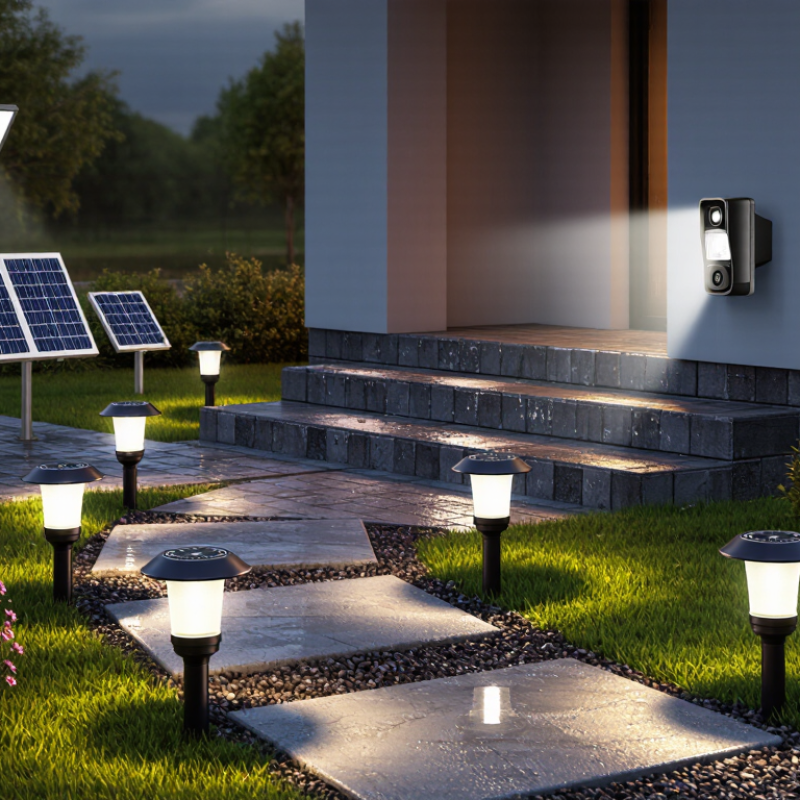
Outdoor solar lights from China are easier to compare by where they will be used. Path lights suit garden edges and walkways, where gentle, downward light helps people see uneven paving. Wall-mounted models work beside gates, porches, and sheds. For wider driveways, motion-sensing floodlights can provide stronger bursts of light without staying fully bright all night. Decorative lanterns create atmosphere, but they are not usually a substitute for task lighting.
Design affects both appearance and performance. Stake lights are simple to move, while wall fixtures need a suitable mounting surface and a panel that receives sun. Some designs use a separate solar panel connected by a cable, which helps when the light sits in shade. Light output matters, too. Around 10–100 lumens may be enough for a path marker; security areas often need several hundred lumens or more. Check whether the stated figure describes peak output or typical operation. Small details matter.
A useful comparison includes panel size, battery capacity, sensor settings, and weather-resistant construction, not just brightness. Look for clear specifications and practical charging guidance. Shade, short winter days, and cold weather can reduce runtime, even with a well-made fixture. I have found that a bright light is not automatically the best choice: glare can make a small yard feel harsh. There is no perfect category, and product figures can be difficult to compare when testing conditions differ.
For outdoor solar lights from China, match battery capacity to your location’s peak-sun-hour data, not a seller’s best-case runtime. The World Bank and ESMAP’s Global Solar Atlas maps long-term solar irradiation, while NREL’s National Solar Radiation Database provides hourly solar and weather data. Check your city’s weaker winter months; annual averages can hide several dim, cloudy days.
Estimate daily panel energy as panel watts multiplied by local peak-sun hours. Then allow for charging and conversion losses. For example, a 3.2-volt, 2-amp-hour battery stores about 6.4 watt-hours nominally. A 0.5-watt lamp running eight hours uses 4 watt-hours, before losses. The match looks close. In real gardens, shade, dirt, and cold can reduce charging, so advertised runtime may not hold. Ask suppliers for battery watt-hours, panel wattage, and test conditions—not just hours claimed.
Tips: Use monthly solar-resource data for your installation site. Compare winter charging against the light’s nightly energy use, and keep a reserve for cloudy days. Small panels beside fences often receive less sun than expected. I would verify the figures with a simple outdoor trial; estimates are not perfect.
For outdoor solar lights, an IP rating helps show how well the enclosure resists dust and water. Under IEC 60529, the first digit describes protection from solid particles; the second describes water resistance. Check the exact rating, not just phrases such as “weatherproof” on a sales page.
For exposed garden paths, IP65 is a practical baseline: it indicates dust-tight protection and resistance to water jets under defined test conditions. It does not mean the light can be submerged. IP67 covers temporary immersion under specified conditions, but that may not suit every installation. Check the whole assembly. A lamp may carry an IP rating while its cable connector or solar panel junction has less protection. Ask for an IEC 60529 test report that matches the model being sold, and confirm the rating applies to the assembled product.
Look closely at seals, screw covers, and cable entry points. A tiny opening can admit rain after repeated heating, cooling, or handling. Ratings describe controlled tests, not years of sun exposure or aging seals. That distinction is easy to overlook. I would treat the IP figure as useful evidence, not a guarantee, and inspect a sample after installation, especially where water collects or sprinklers reach the fixture.
| Light Type | Typical Use | Practical Features to Compare | Suggested Minimum IP Rating | IEC 60529 Rating Meaning | What to Verify Before Buying |
|---|---|---|---|---|---|
| Solar pathway light | Walkways, garden edges, and driveways | Low-level, downward or diffused light; stake or ground-mount installation; dusk-to-dawn or motion-control options | IP44; IP65 for exposed locations | IP44 protects against solid objects 1 mm and larger and water splashing from any direction. IP65 is dust-tight and protected against water jets. | Check whether the rating applies to the assembled light, including the lens, housing, switch, and cable entry—not just an individual component. |
| Solar wall or porch light | Exterior walls, entrances, and covered porches | Wall-mount design; integrated solar panel or separate panel; optional motion sensor and selectable operating modes | IP65 | The first digit, 6, indicates dust-tight construction. The second digit, 5, indicates protection against water jets under the specified test conditions. | Confirm the rating for the complete installed product and check whether the panel or sensor has a different rating from the lamp body. |
| Solar floodlight | Driveways, yards, sheds, and security lighting | Wide beam; adjustable mounting bracket; motion sensor; separate panel can help with positioning in sunlight | IP65; consider IP66 for stronger jet exposure | IP66 is dust-tight and tested for protection against powerful water jets. It does not by itself mean the product is suitable for immersion. | Ask for the test report or certificate for the exact model and check installation instructions, cable connections, and sensor openings. |
| Solar garden stake or decorative light | Flower beds, borders, and accent lighting | Low-power decorative output; stake-mounted housing; replaceable battery may be available on some designs | IP44; IP65 for frequent rain exposure | IP44 covers splashing water, while IP65 provides dust-tight protection and resistance to water jets. Neither rating guarantees resistance to every weather condition. | Check drainage, material and finish details, battery replacement instructions, and any limits for freezing temperatures or prolonged standing water. |
| Solar step or deck light | Stairs, deck edges, and low-level outdoor guidance | Compact, low-glare housing; surface or recessed mounting; installation position affects water exposure | IP65; IP67 where temporary immersion is a credible risk | IP67 is dust-tight and protects against temporary immersion under defined test conditions, commonly up to 1 m for 30 minutes. It is not a general guarantee for permanent underwater use. | Verify that the rating covers the installed configuration and that recesses, seals, and mounting surfaces do not trap water. |
| Solar string or festoon lights | Patios, pergolas, and outdoor decorative lighting | Weather-resistant cable and lamp holders; replaceable bulbs on some designs; solar panel placement and cable length matter | IP44 for sheltered use; IP65 for more exposed setups | IP44 is splash-resistant under the rating test; IP65 is dust-tight and protected against water jets. The rating may differ between the control box, panel, and light string. | Check the IP rating of each component, connector protection, and whether the instructions permit outdoor use during heavy rain. |
| Buying note: IP ratings describe protection against dust and water under specified test conditions; they do not establish brightness, battery life, UV resistance, corrosion resistance, or overall product quality. Treat these ratings as selection guidance, not as claims about any particular product. Before purchasing, verify the exact model’s IEC 60529 test documentation and installation limits. | |||||
When evaluating outdoor solar lights from China, ask for the exact IEC 60598 test reports—not just a certificate image. The relevant standard parts depend on the luminaire’s design and intended use. Check that the tested model, materials, and electrical configuration match the product you plan to order. A report for a similar-looking lamp is not the same evidence.
Paper is not enough. Request dated quality records that connect incoming components to finished batches. Useful examples include inspection logs for seals and wiring, production checklists, and records of corrective actions. Ask how suppliers control changes to the LED board, enclosure, or battery compartment. Small substitutions can affect safety and service life. I find this detail easy to overlook when a sample looks convincing.
Check the testing laboratory’s identity and report scope, then confirm how production units are checked against the tested sample. For outdoor use, ask separately for evidence supporting the stated ingress protection rating; do not assume an IEC 60598 report proves every environmental claim. Request calibration records for test equipment and traceability for a recent batch. Details matter. If a supplier cannot explain a missing record clearly, pause and ask for a specific follow-up document. No single file guarantees consistent quality, but clear records make problems easier to investigate.
Screen Chinese Suppliers for IEC 60598 Safety Testing and Quality Records
IP code digits indicate degrees of protection under IEC 60529: the first digit covers access to hazardous parts and protection against solid objects (0–6); the second covers protection against water (0–9). These are separate classifications, not comparable scores. When reviewing outdoor solar luminaires, check the product’s IP rating alongside relevant IEC 60598 safety test reports and quality records.